
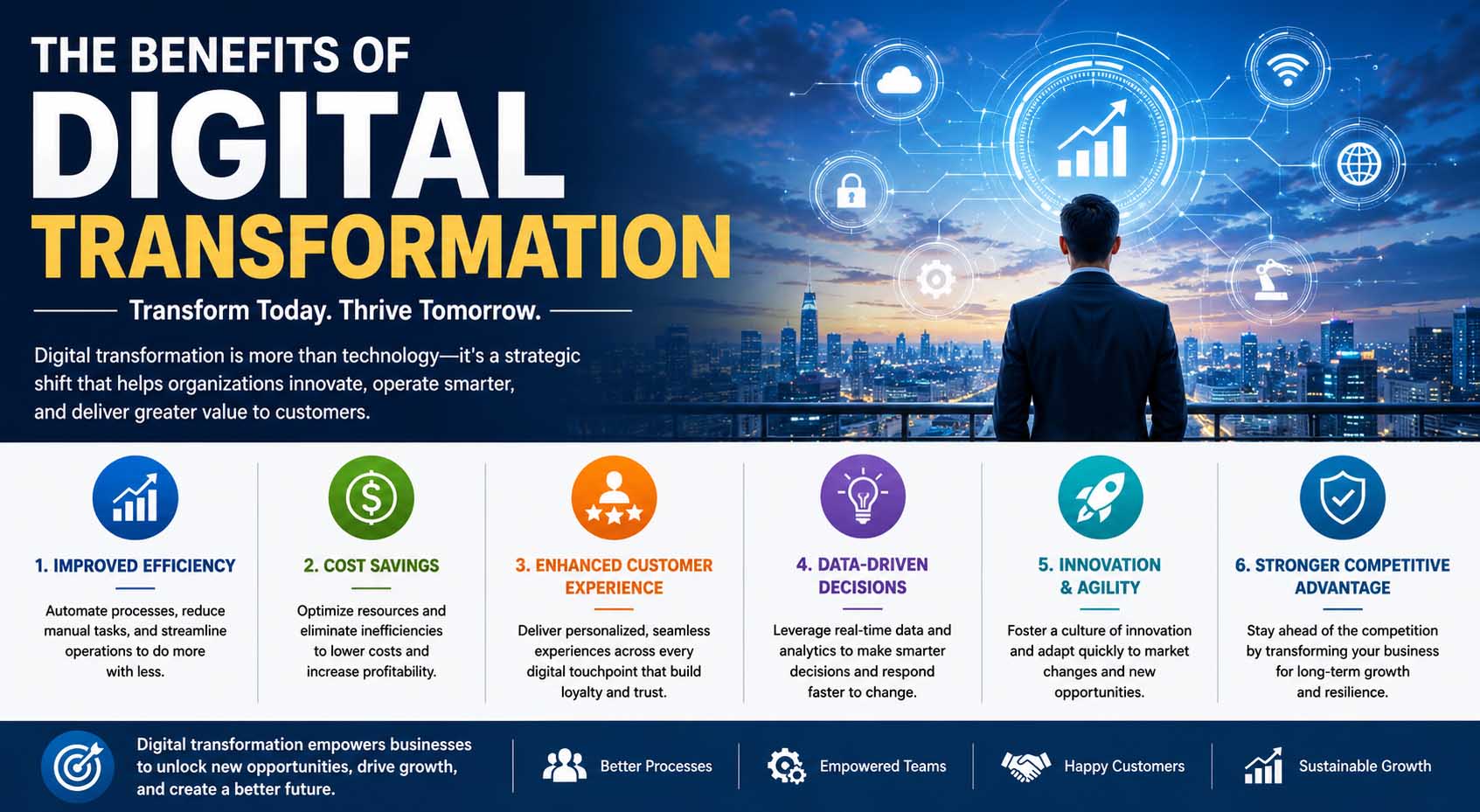
Benefits of Digital Transformation: Why Modern Businesses Can’t Ignore It
Every business reaches a point where manual processes begin slowing growth. Paper-based workflows, disconnected systems, and outdated software can reduce productivity and make it harder to compete. That’s why more organizations are investing in digital solutions and exploring the benefits of digital transformation.
Digital transformation isn’t simply about buying new technology. It’s about improving how a business operates, serves customers, manages employees, and makes decisions. Whether you’re running a startup, a retail store, a healthcare practice, or a large enterprise, adopting the right digital tools can create lasting improvements across your organization.
As technology continues to evolve, businesses that embrace digital transformation are often better prepared to adapt to changing customer expectations, market trends, and competitive pressures.
What Is Digital Transformation?
Digital transformation is the process of using technology to improve business operations, customer experiences, and decision-making.
Instead of relying on manual processes or outdated systems, organizations use digital tools to streamline daily activities and support long-term growth.
Digital transformation may include:
- Cloud computing
- Business automation
- Artificial intelligence (AI)
- Data analytics
- Customer relationship management (CRM) software
- Enterprise resource planning (ERP) systems
- Digital collaboration tools
- Cybersecurity improvements
- Mobile applications
Rather than changing everything at once, many companies introduce digital improvements gradually, focusing on areas that deliver the greatest business value.
Benefits of Digital Transformation in Business
The benefits of digital transformation in business extend far beyond adopting new software. When implemented thoughtfully, digital transformation helps organizations become more efficient, responsive, and customer-focused.
Increased Operational Efficiency
One of the biggest advantages is eliminating repetitive manual work.
Automation reduces time spent on routine tasks such as:
- Data entry
- Invoice processing
- Employee onboarding
- Customer follow-ups
- Inventory updates
- Report generation
Employees can then focus on work that requires creativity, problem-solving, and strategic thinking.
Many organizations seeking Digital Strategy Consulting begin by identifying repetitive workflows that technology can simplify without disrupting daily operations.
Better Business Decisions
Successful businesses rely on accurate information.
Digital tools collect and organize data from multiple sources, giving managers a clearer picture of business performance.
Instead of waiting for monthly reports, leaders can monitor:
- Sales performance
- Customer behavior
- Inventory levels
- Marketing campaigns
- Employee productivity
- Financial trends
Faster access to reliable data helps businesses respond more quickly when conditions change.
Improved Customer Experience
Today’s customers expect speed, convenience, and personalized service.
Digital transformation helps businesses meet those expectations through:
- Faster response times
- Self-service customer portals
- Online scheduling
- Personalized recommendations
- Mobile-friendly experiences
- Real-time order tracking
Happy customers are more likely to return, recommend the business to others, and build long-term relationships.
How Digital Transformation Supports Business Growth
Growth often creates operational challenges.
As companies expand, manual systems become increasingly difficult to manage. Hiring more employees alone doesn’t always solve the problem.
Digital transformation creates scalable systems that support growth without adding unnecessary complexity.
Businesses often experience improvements in:
- Collaboration
- Productivity
- Customer service
- Communication
- Financial reporting
- Resource planning
Technology becomes a foundation that supports expansion instead of slowing it down.
Faster Collaboration Across Teams
Modern workplaces rely on collaboration regardless of employee location.
Cloud-based platforms allow teams to:
- Share documents securely
- Track projects in real time
- Communicate instantly
- Hold virtual meetings
- Manage workflows from anywhere
This flexibility helps businesses operate more efficiently while supporting hybrid and remote work environments.
Stronger IT Infrastructure
Reliable technology is essential for digital transformation.
Many organizations evaluate Managed IT Support Services to ensure their systems remain secure, updated, and available as technology becomes more central to daily operations.
A dependable IT foundation reduces downtime while helping employees stay productive.
Benefits of Digital Transformation in Healthcare
The benefits of digital transformation in healthcare continue to grow as providers adopt modern technology to improve patient care and operational efficiency.
Healthcare organizations now use digital systems for many daily activities, including:
- Electronic health records
- Online appointment scheduling
- Telehealth consultations
- Digital billing
- Secure patient communication
- Automated reminders
These improvements reduce administrative workloads while helping healthcare professionals spend more time caring for patients.
Patients also benefit from quicker access to information and more convenient healthcare services.
Benefits of Digital Transformation in Retail
The benefits of digital transformation in retail are easy to see in today’s shopping experience.
Customers now expect businesses to provide both online and in-store convenience.
Retailers use digital technologies to improve:
- Inventory management
- Mobile shopping
- Personalized marketing
- Self-checkout systems
- Customer loyalty programs
- Order fulfillment
Real-time inventory visibility also helps businesses reduce stock shortages while improving customer satisfaction.
Retailers that combine physical stores with strong digital experiences are often better positioned to compete in changing markets.
Leadership’s Role in Successful Digital Transformation
Technology alone doesn’t create successful transformation.
Leaders must communicate clear goals, encourage employee involvement, and provide the training people need to use new systems effectively.
Successful digital transformation usually follows a simple process:
- Identify business challenges.
- Set measurable goals.
- Select the right technology.
- Train employees.
- Measure results.
- Continue improving over time.
Organizations frequently seek IT Strategy Consulting before making major technology investments to ensure new systems align with business objectives instead of creating unnecessary complexity.
Building a Digital-First Workplace
Digital transformation also changes how employees work.
Instead of relying on disconnected tools, businesses can create integrated systems where departments share information more efficiently.
This often leads to:
- Faster communication
- Fewer manual errors
- Better project visibility
- Improved customer service
- Stronger teamwork
When employees have access to reliable technology, they spend less time solving system problems and more time creating value for customers.
Benefits of Digital Transformation in Insurance
The benefits of digital transformation in insurance are reshaping how insurers serve customers and manage operations. Traditional insurance processes often involve lengthy paperwork, manual approvals, and slow claims handling. Digital tools help remove many of these bottlenecks.
Insurance companies are using technology to:
- Automate claims processing
- Improve fraud detection
- Offer online policy management
- Speed up customer support
- Analyze risk with data-driven insights
- Deliver personalized insurance products
Customers appreciate faster service and greater transparency, while insurers can reduce operational costs and improve accuracy.
A Comparison: Traditional Business vs. Digitally Transformed Business
The impact of digital transformation becomes easier to understand when comparing day-to-day operations.
| Business Area | Traditional Approach | Digitally Transformed Approach |
|---|---|---|
| Communication | Emails and paper records | Cloud collaboration platforms |
| Customer Service | Phone and in-person support | Multi-channel digital support |
| Data Storage | Local files and spreadsheets | Secure cloud-based systems |
| Reporting | Manual reports | Real-time dashboards |
| Decision Making | Based on historical information | Driven by live business data |
| Workflow | Manual approvals | Automated workflows |
| Employee Collaboration | Department silos | Shared digital workspaces |
This comparison shows that digital transformation is about improving processes rather than simply replacing old technology.
Common Challenges During Digital Transformation
Although the advantages are significant, businesses often encounter obstacles during implementation.
Recognizing these challenges early makes planning much easier.
Employee Resistance
People naturally become comfortable with familiar systems.
When new software is introduced without proper communication or training, employees may hesitate to adopt it.
Business leaders can reduce resistance by explaining:
- Why the change is happening
- How it benefits employees
- What training will be available
- How success will be measured
Keeping employees involved throughout the process encourages stronger adoption.
Budget Constraints
Digital transformation is an investment.
Businesses should prioritize projects that solve meaningful operational problems instead of purchasing technology simply because it’s popular.
Starting with high-impact improvements often delivers faster returns while reducing financial risk.
Integration with Existing Systems
Many organizations rely on older software that still performs important functions.
Before implementing new platforms, businesses should evaluate whether existing systems can integrate smoothly or require gradual replacement.
A phased approach often reduces disruption while allowing teams to adjust over time.
Best Practices for a Successful Digital Transformation
Technology works best when supported by a clear business strategy.
The following practices help organizations improve their chances of success.
Start with Business Goals
Don’t begin by choosing software.
Instead, identify the business problems you want to solve.
For example:
- Reduce administrative work
- Improve customer satisfaction
- Increase operational efficiency
- Support remote collaboration
- Improve reporting accuracy
Technology should always support business objectives rather than becoming the objective itself.
Invest in Employee Training
Even the best software provides limited value if employees don’t know how to use it.
Provide:
- Hands-on training
- User guides
- Ongoing support
- Regular feedback sessions
Employees who understand new tools are more confident and productive.
Measure Progress
Track measurable outcomes such as:
- Time saved
- Customer satisfaction scores
- Revenue growth
- Process completion times
- Error reduction
- Employee productivity
Reviewing these metrics helps businesses refine their digital strategy over time.
How Digital Transformation Supports Every Department
Digital transformation isn’t limited to IT.
Every department can benefit from improved systems.
Marketing
Marketing teams use automation, analytics, and customer insights to deliver more relevant campaigns and measure results more accurately.
Sales
Sales professionals can access customer information, manage leads, and monitor opportunities through integrated CRM platforms.
Human Resources
Digital HR systems simplify recruitment, onboarding, payroll, and employee records.
Many growing companies also explore the benefits of hr outsourcing alongside digital transformation to modernize HR processes while allowing internal teams to focus on strategic initiatives.
Finance
Finance teams gain better visibility through automated reporting, digital invoicing, expense tracking, and forecasting tools.
Common Misconceptions About Digital Transformation
Several myths discourage businesses from getting started.
“It’s Only for Large Companies”
Small businesses often benefit the most because digital tools help them compete more effectively without significantly increasing staffing costs.
Cloud software has made advanced business technology more affordable than ever.
“It’s Just About Technology”
Technology is only one part of the process.
Successful transformation also involves leadership, employee engagement, process improvement, and continuous learning.
“Results Happen Immediately”
Meaningful change takes time.
Most businesses achieve the best results through steady improvements rather than one large technology rollout.
Frequently Asked Questions
What is digital transformation?
Digital transformation is the process of using technology to improve business operations, customer experiences, and decision-making through modern digital tools and streamlined workflows.
What are the biggest benefits of digital transformation?
Some of the most valuable benefits include improved productivity, stronger customer experiences, better decision-making, increased operational efficiency, and greater business agility.
Is digital transformation expensive?
Costs vary depending on the size of the business and the scope of the project. Many companies begin with smaller improvements and expand their digital capabilities over time.
Which industries benefit the most?
Nearly every industry can benefit, including healthcare, retail, insurance, manufacturing, finance, education, and professional services.
Does every business need digital transformation?
Every business has different needs. However, companies that rely on outdated manual processes often discover opportunities to improve efficiency, customer service, and long-term competitiveness through digital improvements.
Organizations evaluating their technology roadmap often compare the benefits of managed it services with building larger internal IT teams, especially as digital operations become more complex.
Moving Forward with Digital Transformation
The benefits of digital transformation go far beyond adopting new software. The real value comes from creating smarter processes, improving customer experiences, empowering employees, and building a business that can adapt as markets evolve.
Whether you’re running a small business or leading a growing enterprise, start by identifying the areas where technology can solve real operational challenges. Focus on clear business goals, involve your employees throughout the process, and measure progress as you implement changes.
Businesses that improve step by step, invest in the right technology, and continue refining their processes are better prepared for future opportunities and changing customer expectations.